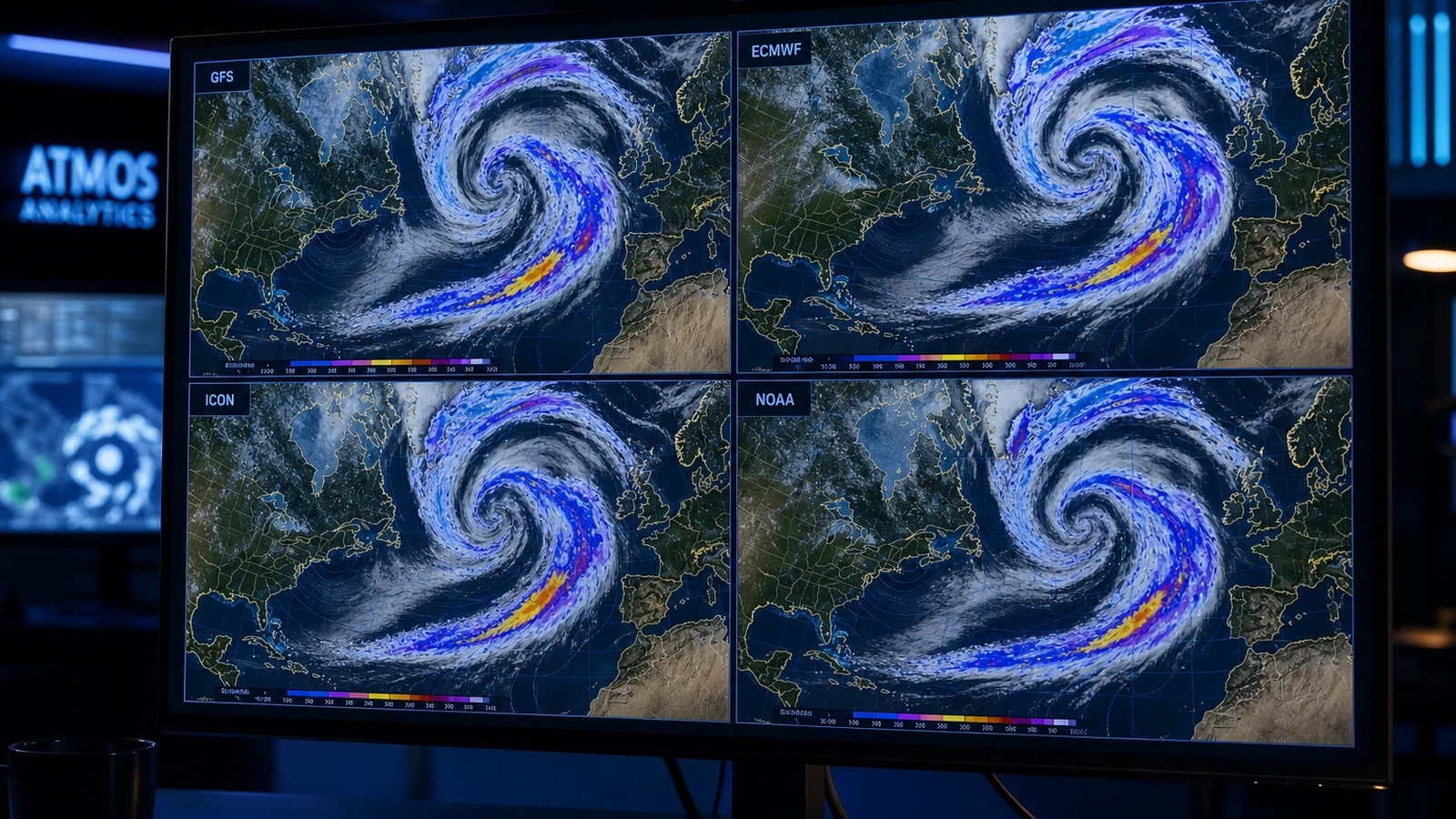
The forecast you see on your phone is usually a blend — your weather app silently merges multiple numerical models and surface adjustments. For trading, that blend is the enemy. You need to see the raw model outputs and the disagreements between them. Here's the practical guide to the four models WIN Weather Bot reads.
ECMWF — the European standard
The European Centre for Medium-Range Weather Forecasts in Reading runs the most accurate global model for 3–10 day forecasts, by a consistent margin in independent verification scores. Strengths: large-scale flow patterns, synoptic features, jet stream behavior. Run twice daily (00/12 UTC). Latency: ~7 hours after init. Use case for trading: medium-range markets (3+ days out), high-confidence directional bets when ECMWF stands alone against the others.
GFS — the American workhorse
NOAA's Global Forecast System runs 4 times daily (00, 06, 12, 18 UTC) on a 13 km grid globally. Strengths: fast updates, free public access, decent short-range accuracy. Weakness: known cold bias in winter, occasional dramatic flip-flops between runs as new data arrives. Use case for trading: short-range (1–3 day) markets, especially in the Americas. The 4 runs/day mean more decision points.
ICON — the German regional specialist
The DWD's ICON model runs every 3 hours on a global 13 km grid, with a 6.5 km nested grid over Europe. Strengths: best resolution over Europe, fast updates, excellent handling of Alpine and coastal microclimates. Use case for trading: European weather markets, particularly when ECMWF and GFS disagree and you want a tiebreaker. Pay attention especially when ICON's Europe nest gives a temperature 2°C+ off the other two — that's often where the edge lives.
NOAA HRRR — the US short-range hammer
The High-Resolution Rapid Refresh runs hourly on a 3 km grid over the contiguous US. Strengths: sub-day forecasts with extreme detail, captures convective initiation, urban heat island effects. Use case for trading: any US city market with same-day resolution. Outside the US it's irrelevant.
How disagreement becomes signal
Three patterns worth trading
The most actionable patterns aren't when all four models agree on a temperature — those are already priced. The patterns that matter:
- Three-of-four consensus: ECMWF + GFS + ICON agree, NAM/HRRR disagrees → usually trust the three. Trade the consensus direction.
- Outlier flip: ECMWF revises its forecast by 2°C+ between runs and the others haven't caught up yet → fade the old market price toward the new ECMWF.
- Late ICON divergence: ICON's overnight Europe run shows a fog/inversion pattern that the global models missed → small high-confidence bets on threshold markets.
The ensemble weight
The bot uses dynamic weights: ECMWF gets 35–45% in medium range, GFS 20–25% in short range, ICON 25–35% in Europe-only markets, HRRR ~30% for US same-day. The exact weights are tuned per region and per forecast horizon based on backtests. The takeaway: never trust a single model when you can blend four.